Understanding AI SEO: How structured data makes websites visible to modern AI systems
l
Webdesign
Webentwicklung
Branding
Animation
We are Blue World Studio from Düsseldorf. We develop websites, technical SEO and GEO systems and AI-optimized information architecture that perform creatively, strategically and based on data. Everything in-house.
This deep dive shows how companies technically structure websites in such a way that modern AI such as Chat GPT, Gemini or other llms correctly read, model and incorporate content into answers. Most companies lose visibility because there is a lack of technical basics and machine-readable content remains unclear. Studies show that around 88 percent All pages do not use a scheme. Whoever structures early gains reach, trust and rank in the AI search.
Why AI is redefining the SEO game rules
The mechanics of the search are changing radically. Classic SEO is no longer enough. Modern AI systems combine language, data, and modeling to understand content. Content must therefore not only be convincing from a human point of view, but must also be clearly structured from a technical point of view. Natural language processing requires clear signals, consistent data, and an architecture that enables contextual classification. The development of Answer Engine Optimization shows that visibility in future search results depends on how cleanly a page is structured. AI extracts excerpts of content, relinks them and builds answers from them. That is precisely why the technical structure is becoming a central CMO task.

Why AI systems prioritize technical structure as a relevance factor
Modern LLMs don't work like traditional search engines. They're not just crawling. They interpret.
They recognize meaning through data, linguistic patterns, internal links, and structured data. Pages without a clear architecture lose visibility because AI cannot correctly display content.
The result: No rich snippet, no ranking, no mention in AI answers. Companies that optimize their site for AI gain competitive advantages. AI understands topic clusters better, recognizes relationships and evaluates expertise more precisely. This creates a new playing field for SEO strategies that use machine-readable structure as a core.
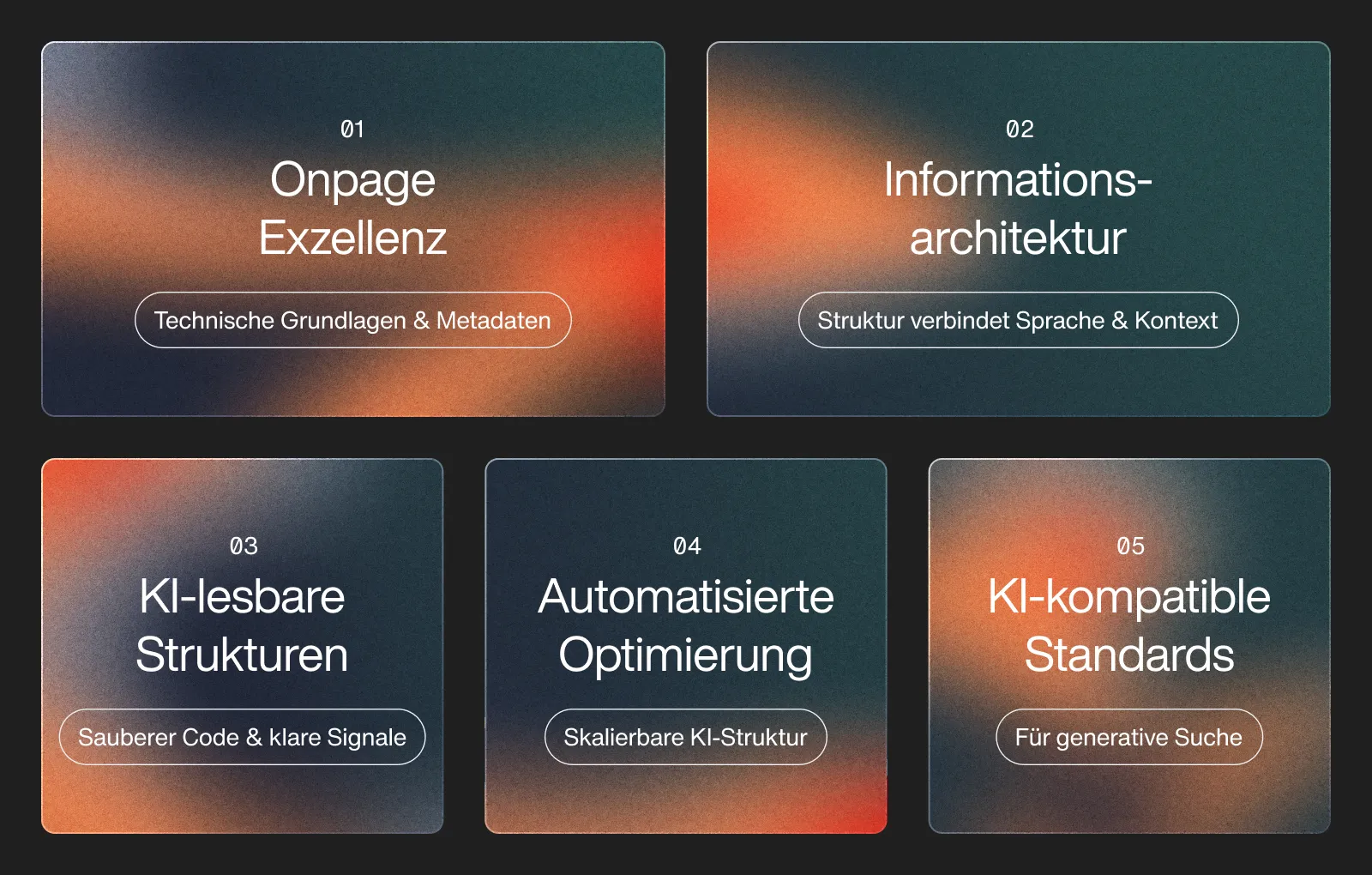
Stage 1: Onpage excellence as the foundation of your AI visibility
Technical optimization starts with the basics. What you get: Precise title tags, clear meta descriptions, and clean hierarchies. Old texts that make speech unique and remain machine-readable.
Internal linking that shows connections. A page that ensures crawlability. Data analysis that reveals technical errors Metadata that defines theme spaces. This basis determines how well NLP and AI models understand content and whether it appears in generated answers. For CMOs, this is the basis of any modern SEO strategy.
Stage 2: Information architecture that combines structure and language
Webflow showsthat AI recognizes content best when websites are consistent and modular. Recurring content patterns make classification easier for llms. What we recommend: Use structured data systematically to clearly define content. Design navigation in such a way that theme rooms are clearly and logically linked. Use rich snippets as a sign of trust. This architecture makes content understandable for systems that interpret language via structure. This creates transparency, relevance and technical clarity.
Stage 3: Structures that modern AI can actually read
AI does not analyze content linearly. It breaks down pages into smaller sections, checks connections and models meaning. This requires technical stability, fast loading times and clear awards.
What we recommend: Clean code base so that AI systems process content reliably. Accessibility audits for machine-readable results. Structured data for recurring page types. Clear signals that show how content should be prioritized. Pages that meet this standard are better understood by AI and incorporated into answers more often.
Stage 4: Automation as a lever for scalable AI optimization
Growing brands need systems that make technical quality reproducible. Automation is becoming a strategic advantage.
What you get: Automated structured data, standardized content modules, automatic verification of metadata, alt texts and internal links. Tools that detect technical errors early on. This creates a platform that remains consistently AI-compatible and ensures long-term visibility. Automated optimization creates scalability, efficiency and reliable SEO structure for every new site.
Stage 5: The next generation of AI-compatible standards
The future of SEO belongs to systems that clearly communicate which content AI can prioritize. Webflow shows that technical AEO becomes the new standard. What you get: AI-friendly architecture, machine-clear structure, and unique information for modern models. Companies that understand this development early on secure reach in generative search results. This strengthens brand authority, trust and long-term visibility.
Conclusion
AI requires structure. AI requires data clarity. AI requires technical precision. Companies that structure websites cleanly create the basis for modern visibility, high relevance and strong performance in AI-generated answers.
We combine technology, voice and data to create a system that has a lasting effect. Everything in-house.
FAQ
Why is structured data crucial for AI SEO?
Weil KI Modelle Informationen nur korrekt interpretieren, wenn Bedeutungen eindeutig ausgezeichnet sind.
How does NLP support website content recognition?
NLPs extrahieren Bedeutungen aus Sprache und benötigen klare technische Signale, um Inhalte zuverlässig zu verstehen.
Why is Answer Engine Optimization becoming so important strategically?
AEO erhöht die Chance, in KI Antworten aufzutauchen und stärkt die Sichtbarkeit in modernen Suchergebnissen.
How do I optimize my site for AI search?
Through technical SEO, structured data, clear information architecture and consistent content modules.
What are the benefits of automation?
It creates scalable optimization, technical consistency, and long-term visibility in AI systems.