SEO vs GEO: Why Generative Engine Optimization is changing the future of search and how brands must react now
l
Webdesign
Webentwicklung
Branding
Animation

initiation
We are Blue World Studio from Düsseldorf. We design digital brands, websites and SEO/GEO systems that perform strategically, creatively and based on data. Everything in-house. In this deep dive, we analyze why GEO (Generative Engine Optimization) Is becoming one of the most important topics in B2B marketing and why it is not a substitute for SEO, but logical development.
Based on Analyzing Ahrefs, our own strategy work and current developments in the AI ecosystem, we show how digital visibility is changing. And why brands that think Geo instead of Seo secure their competitive advantage.
This article is aimed at CMOs, marketing decision makers, and teams who want to understand how SEO vs GEO will determine future digital success.
Do you want to know what GEO actually means for your brand? We will analyze your current SEO structure and show you how you can now directly contribute to GEO.
Check potential now.
SEO is here to stay, GEO is coming and search systems are changing faster than ever before
Search engines such as Google are based on indexing, ranking factors and classic SEO signals. But with the rapid development of AI search systems such as ChatGPT, Perplexity and Gemini, the digital landscape is fundamentally changing. Instead of ten blue links appear Generative Responses, summarize the information — often without clicking, but with references.
It starts right here GEO (Generative Engine Optimization).
While SEO aims to To be visible in search engines, GEO aims to Emerge as a Trusted Source in AI Answers.
Loud Ahrefs There are two parallel realities today:
- SEO Ensures rankings, traffic, clicks, and organic growth.
- GEO Ensures that AI models name a brand as a source, quote it or highlight it in generative answers.
For brands, this means:
Anyone who wants to remain visible in the future needs both.
We combine SEO and GEO in one system. If you want to understand how both channels work together and where your biggest growth potential lies, Let's talk.
SEO vs GEO: What the difference really means
The “geo vs seo” debate is often blurred. Many misunderstand GEO as an alternative. In reality, it is a widening.
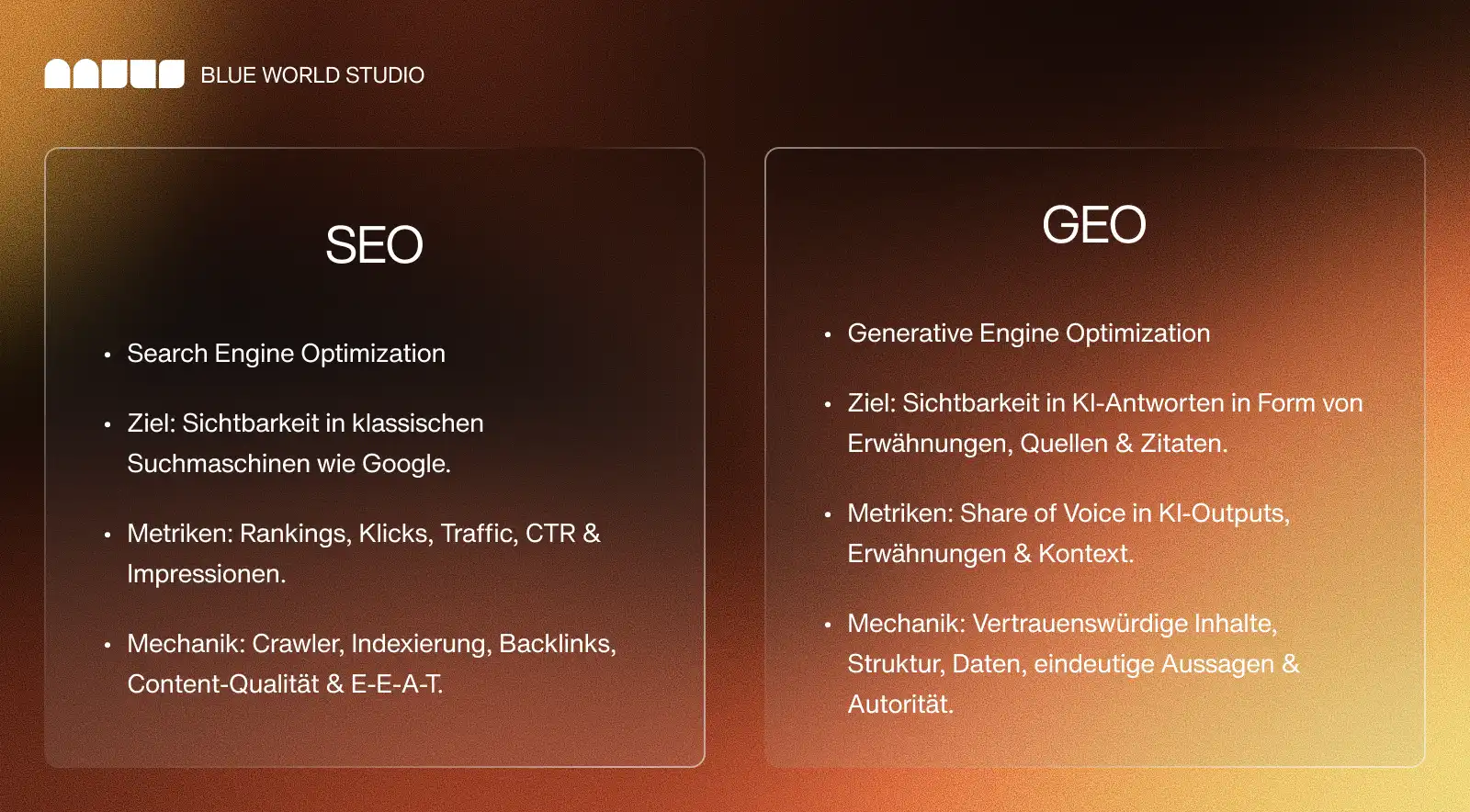
SEO (search engine optimization)
Target: Visibility in classic search engines such as Google.
Metrics: rankings, clicks, traffic, CTR, impressions.
Mechanics: crawlers, indexing, backlinks, content quality, E-E-A-T.
GEO (Generative Engine Optimization)
Target: Visibility in AI Answers — in the form of references, sources or direct quotations.
Metrics: Share of voice in AI outputs, frequency of mentions, context of engagement.
Mechanics: Trustworthy content, clear structure, precise data, unambiguous statements, strong authority.
Short version:
SEO brings people to your website. GEO gets your website into AI answers and then onto your website.
Both are crucial.
GEO doesn't work without the basics of SEO.
Why GEO is created: AI search systems are changing the information space
Ahrefs Shows clearly: AI models today answer enormous amounts of general search queries directly in the interface, without a classic click. Create SERPs instead Geo zones: Responses that synthesize various sources.
These answers are based on:
- structured information
- precise statements
- trusted sources
- Easily citable formulations
- Clear Definition Sections
- Data points and comprehensible facts
GEO is therefore not created by “optimizing AI,” but by Optimizing content that uses AI.
AI favors content that:
- Are clearly structured
- Contain precise sets of definitions
- Are neatly formulated
- Are clearly citable
- Deliver consistent data
- Have authority
What does that mean?
Brands must produce content that Both people and machines understand.
We develop content that cites AI models. Accurate, structured, fact-based. When You want geo-ready contentThat appears in AI Answers Get in touch.
GEO instead of SEO? Why this idea is dangerous
Many are already asking:
“Should we do GEO instead of SEO? ”
The answer is clear: No
Why
- Geo builds upon SEO on. Without indexing, visibility, and authority, an AI model becomes your content Not Use.
- AI models continue to train on Google's top results.
- Backlinks, domain authority, and expertise remain essential signals.
- GEO is new, unstable, and constantly evolving.
- SEO remains the channel that delivers traffic, leads, and predictable performance.
GEO doesn't replace SEO — it complements it.
SEO remains your foundation. GEO expands it. We build systems that bring together updates, AI search and classic rankings. Let's modernize your strategy.

How GEO really works: Content that AI cites
GEO requires content that Precise enough for machines and valuable enough for people Are.
Exemples:
- Glossaries with clear definitions
- precise “What is...? “Sections
- structured FAQ sections
- Industry Reports with Data
- Deep-dive content that clearly explains problems
- Content with clear KPI and framework terms
- Clear positions on specialist topics
The goal:
Machines must recognize that your content is the best answer.
How do I find a GEO SEO agency?
A good agency today must master both: SEO and GEO. When you choose a geo-SEO agency, make sure that they:
- Mastered modern SEO
- Understands AI models and their training logic
- Produced content that is machine-readable and citable
- Clear structures used
- Build thought leadership in content
- Source-capable writes
- Provides deep technical context instead of marketing phrases
- Has Experience with AI Search Systems
- Carry out your own tests with ChatGPT, Perplexity, Gemini, etc.
- GEO combined with SEO and not sold as trend hype
An agency that looks at GEO in isolation doesn't understand the market.
An agency that ignores SEO destroys the base.
We are one of the few teams that Connect SEO and GEO in-house. If you're looking for an agency that technically understands how AI search systems work, Then talk to us.”
The most important findings from “SEO vs GEO”
Ahrefs Clearly summarizes the debate:
- SEO remains the basis of digital visibility.
- GEO becomes decisive the more AI search systems are used.
- AI does not replace classic SERPs, but it massively changes them.
- GEO means: Delivering content that uses AI models Be able to quote.
- Brands must structure their content so that it works optimally for both Google and AI.
We see:
The future belongs to brands that Connect both systems at an early stage.
7. Strategic Derivations for CMOs
For B2B brands, this means:
- Rethink SEO Strategy: Ranking + sourcability.
- Structure content twice: People + machines.
- Fact-based content instead of marketing claims.
- “Answer-first” structuring for AI outputs.
- Strengthen E-E-A-T: Make expertise visible.
- Build thought leadership as a data source.
- Longform content Prefer because AI uses deeper sources.
- Develop a concept for GEO monitoring: Where are we mentioned?
- Introduce a new metric: “Share of voice in AI answers.”
It's not a future scenario — it starts now.
We support brands in the transition from SEO to SEO+GEO. With clear frameworks, data-based structures and measurable impact logic. If you want to be visible in AI search systems, now is the time.
Conclusion
SEO remains essential. Rankings, indexing, and organic traffic form the foundation of every digital strategy. But GEO is adding a new level to this foundation: Visibility in AI systems.
Brands that rely on GEO early on are building up a head start in the next generation of search.
Brands that wait lose visibility — long before they know it.
SEO brings traffic. GEO brings authority. We deliver both.
FAQ
What does GEO vs SEO mean?
SEO optimized for search engines. GEO optimized for AI response systems.
What does GEO mean instead of SEO?
It means that SEO is the basis and GEO is a strategic extension for generative search systems.
How do I find a GEO SEO agency?
Make sure that it combines SEO basics, AI understanding, and structured content design.
Why is GEO becoming important?
Because AI search results are growing and brands must remain visible in answers, not just in SERPs.
Does GEO replace classic SEO?
No GEO only works with SEO. It is an extension, not an alternative.