Why brands are switching to Webflow: Speed, Control, and a digital system that truly scales
l
Webdesign
Webentwicklung
Branding
Animation
initiation
We are Blue World Studio from Düsseldorf. We develop digital brands that are fast, flexible and scalable. Everything in-house. In this deep dive, we analyze why more and more companies are switching from classic CMS systems such as WordPress to Webflow and how the platform is becoming the central technical basis of modern brands.
Webflow combines web design, web app, content management system, hosting, design freedom and scaling in one platform. For brands that take their online presence seriously, this change is not a trend, but a strategic decision.
Digital reality instead of technical dependency
Many companies face the same challenge: classic CMS systems create complexity, dependency and high costs. Plugins, Plugs, Updates, Security Risks, and Technical Bottlenecks Slow Down Marketing Teams. The result is slow websites, overburdened developers, and a brand that doesn't deliver the digital performance it promises.
Studies showThat just a few seconds of loading time determine conversion and perception. Webflow offers companies a solution that bundles design, CMS, scaling, hosting and content into one system. The platform enables a modern, dynamic online presence that makes brands faster, more flexible and more independent.

1. What Webflow is and why the platform wins in an enterprise context
Webflow is a visual content management system that combines web design, development, and content in real time. Teams work with it without technical barriers, without plugins and without unnecessary overhead.
Why Webflow is more relevant for companies today than classic website builders or complex open-source systems:
- Visual, component-based work without code requirement.
- A high-performance hosting system including SSL encryption, CDN and stable infrastructure.
- Design freedom for home pages, landing pages, CMS collections, and complex webflow websites.
- Seamless collaboration between design, content, and development.
- Webflow CMS and Webflow Editor enable quick content updates and clear processes.
Webflow thus bridges a gap between simple construction kits and oversized CMS systems. WordPress only remains useful as an alternative where highly individual backend systems are needed.
For everyone else, Webflow is the system that combines speed and precision.
2. Why brands change: Autonomy, speed and predictable costs
Switching to Webflow is essentially a strategic marketing decision, not a technical experiment. Companies want full control over content, designs, functions, and processes.
Key benefits:
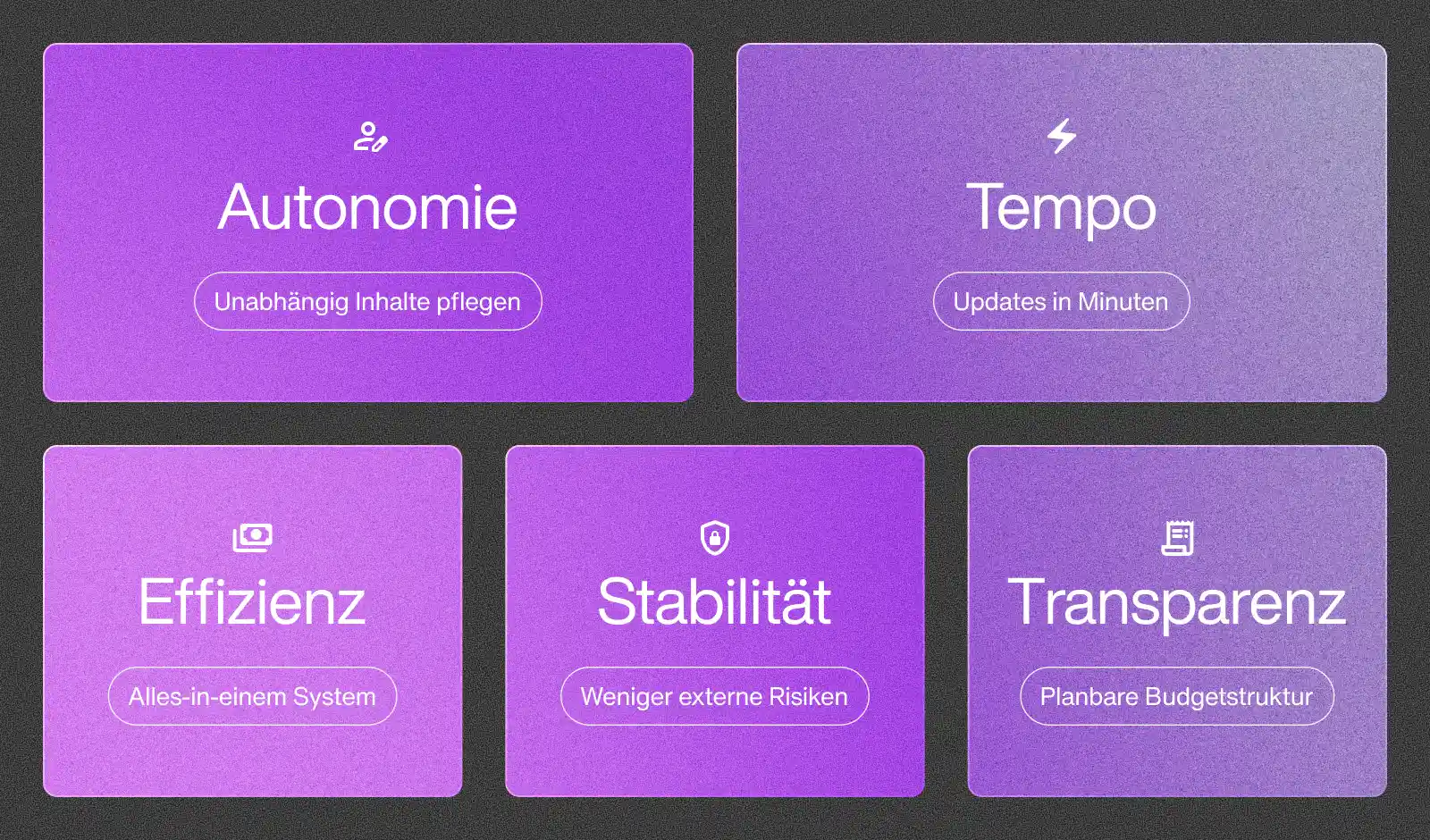
- Autonomy for content teams that update content without a developer.
- 75 percent faster content updates loudly Loop.com Case Study.
- Reduced costs because hosting, CMS and functions are all in one system.
- Significantly less reliance on plugins and third-party solutions.
- Clear, calculable prices instead of complex hosting and developer budgets.
Webflow for companies means a system that combines UX, brand and technology. No stuck updates, no security breaches, no plugin maintenance. Just speed, precision and consistent brand management.
3. Loop.com Case Study: Switching from Contentful to Webflow compared to Framer and other modern systems
Loop.com shows how Webflow solves systemic challenges that arise with Contentful, WordPress or Headless Architectures. Contentful is powerful when complex backend structures are needed. For marketing teams, however, it means greater technical dependency, longer development cycles, and a system that is primarily controlled by developers. This is exactly where frictional losses occur, which slow down growth.
At the same time, Framer is gaining visibility in the market. Framer combines design and CMS in a visual system that gives designers a lot of freedom. However, the tool has clear limits when it comes to scalable enterprise use. Hosting, performance, SEO depth, multilingual architectures, rollout logic and team processes are less sophisticated in comparison. Framer is a design-first system that enables creative implementation, but is not optimized for large amounts of content or enterprise structures.
Switching to Webflow was therefore a strategic step for Loop.com. Webflow combines design, development, CMS and hosting in one system, solving two challenges at the same time: less dependence on developers and a clear focus on scaling. The platform offers a combination of design freedom, enterprise features, performance and a visually controllable CMS.
Objectives of migration:
- Maintain content faster.
- Relieve developer capacities and reduce costs.
- Speed up time to market.
- Keep design flexible and brand-compliant.
- Use a system that is visual, scalable, and team-friendly.
Webflow website results:
- 75 percent faster updates, from one hour to 15 minutes.
- Reduced costs by eliminating unnecessary development cycles.
- Better user experience, higher conversion, and faster load time.
- Plannable hosting structures through Webflow Enterprise.
- More autonomy in marketing and less technical complexity.
The comparison clearly shows:
Contentful is complex and development-intensive, Framer is design-oriented and suitable for smaller structures. Webflow is the system that combines design, scale, autonomy, and enterprise security in one setup. That is exactly why the Platform for Modern Brands is the solution that combines speed, control and market presence.
4. Webflow for agencies and companies: A system that really scales
We at BWS Use Webflow when brands need a system that combines flexible web design, high scaling and rapid implementation.
Why Webflow is ideal for agencies and companies:
- Design systems and component libraries speed up development.
- No plugins and no technically fragile add-ons.
- Webflow CMS makes large amounts of content structured and maintainable.
- Webflow Enterprise provides security, performance, and team structures.
- Responsive design is integrated, not additive.
For brands, this means that the platform becomes a digital foundation. The online presence becomes consistent, scalable and free from technical blockages.
For teams, this means less maintenance, more focus on content and marketing.
5. Strategic Derivations: Webflow as the Future of Brand Web Design
Webflow is changing the landscape of CMS systems. Brands want a system that is flexible, responds to growth and works without technical silos. WordPress, plugins and classic construction kits are reaching their limits.
Our recommendation:
- Use Webflow when design, scale, and autonomy are critical.
- Only use complex systems when structural backend functions are absolutely necessary.
- Choose content management systems based on team skills, not tradition.
- Strategically build Webflow CMS as a content infrastructure.
- See websites as living systems, not as static projects.
Webflow combines hosting, CMS, design, SEO and content in one system. That is exactly what makes the platform so strong.
Conclusion
Webflow provides speed, control, and true scale
Modern brands need a system that combines speed, control, and precision. Webflow offers just that: a platform system that combines content, brand and technology. Companies benefit from rapid development, better user experience, and clear scaling. Agencies get tools that maximize creative freedom.
We develop Webflow projects that are visually strong, technically clean and measurably successful. Everything in-house.
FAQ
What makes Webflow so strong compared to classic CMS systems?
Webflow combines design, hosting, CMS and scaling in one platform and reduces technical dependencies.
Is Webflow an alternative to WordPress?
Yes WordPress is plugin-based and technically more complex. Webflow is faster, more stable, and provides an integrated development environment.
How do CMS collections work in Webflow CMS?
They structure content and make it maintainable without a developer.
What are the benefits of Webflow for companies?
Autonomy, speed, design freedom, performance, lower costs and a better customer experience.
How does BWS support the development of Webflow websites?
With UX, web design, development, CMS structure, SEO and hosting setup. Everything in-house, without silos.