Web Design Trends 2026:5 Innovative Websites and What Modern Web Design Can Learn from Them
l
Webdesign
Webentwicklung
Branding
Animation
Websites are becoming increasingly interactive systems in 2026. Content is rendered live, interfaces react in real time and users no longer move linearly through pages, but through experiences. Viewers become participants.
This development is changing the rules for modern web design. Modern web design is moving its core away from asking what something looks like to asking what a website feels like. Interaction becomes a carrier of information. Movement becomes part of communication. Whoever is convincing today does not retain users through explanations, but through participation.
2026 wants to make it clear which digital products attract attention and which remain interchangeable. What is decisive is not the use of new technologies, but how consistently interaction, performance and UX design work together. It will be particularly exciting where modern websites are already making these principles visible today. That's exactly why it's worth taking a look at current examples that show how interactive systems on the web are already working.
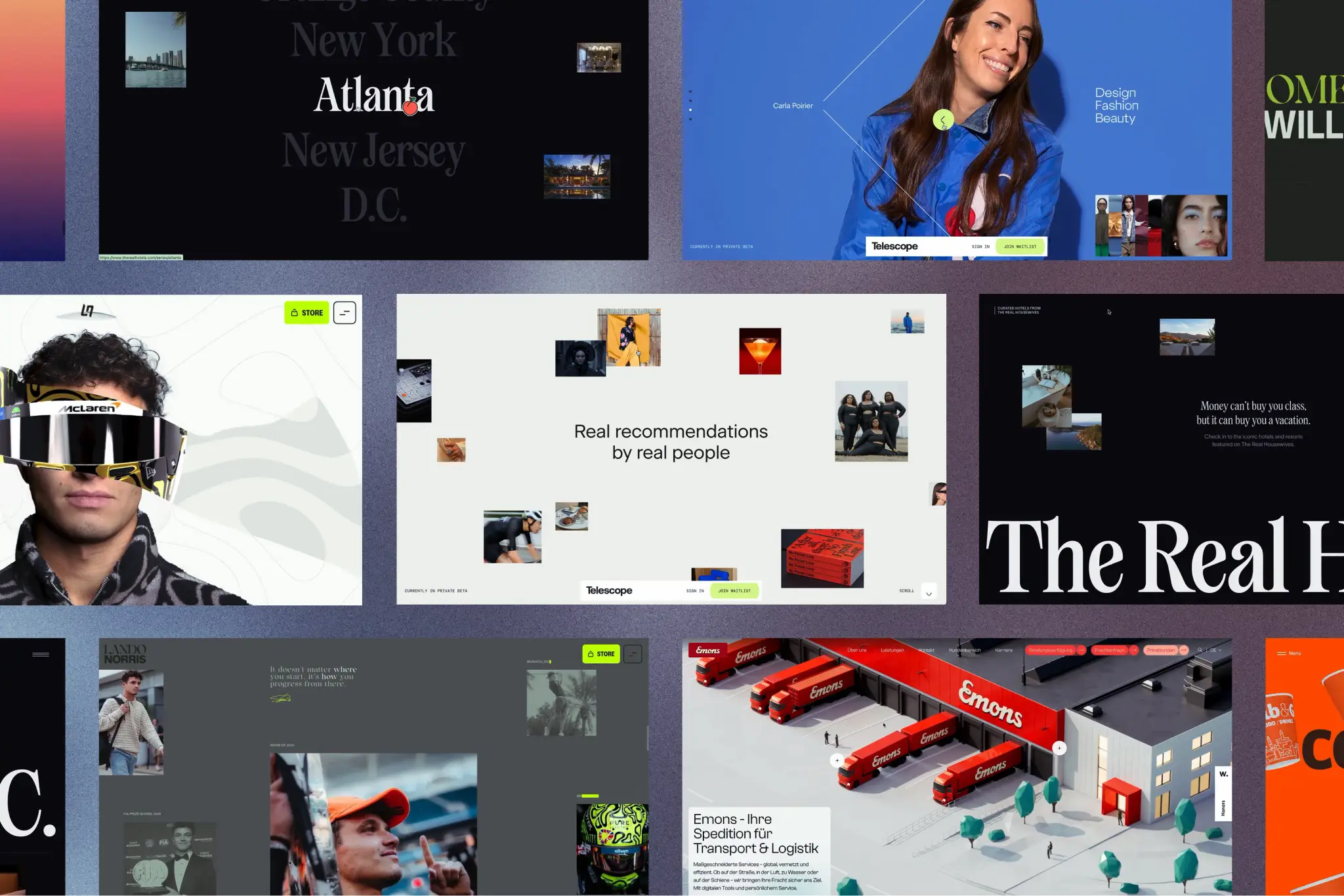
Emons Logistics: Orientation instead of Distraction
The Emons Logistics website shows how web design trends 2026 can be implemented concretely and functionally.
The project by Blue World Studio Was published in the latest Webflow article”8 Web Design Trends to Watch in 2026“Highlighted as an example of guided scrolling. An approach that sees scrolling not as pure movement, but as a consciously guided user interface.
The website works with clear steps, comprehensible progression and targeted storytelling. Users are not overloaded, but guided. Content builds on each other logically; orientation is created through structure, not through explanations. This is precisely the strength of guided scrolling as a UX principle.
The fact that Webflow highlights this project as a particularly relevant trend confirms the approach of BWS. Well-thought-out user guidance, intentional interaction and clear UX are increasingly becoming central components of modern websites. Emons Logistics Shows how these principles can be translated into a high-performance, understandable and scalable web design system.
Telescope: When Interaction Becomes the Introduction to Content
The website of Telescope Doesn't work like a classic product page. Content is not immediately fully visible. They develop through movement and exploration. Users decide for themselves how deep they go.
The site feels more like an interface than a website. Telescope deliberately integrates hidden content and rewards curiosity with small discoveries. Certain content functions as Easter eggs. For example, when you click on seemingly static images, they suddenly change or are replaced by new visual layers. This mechanism reinforces the feeling of not only consuming content, but also actively revealing it.
In the context of web design trends 2026, Telescope thus stands for a clear shift. Websites become spaces that want to be explored, not pages that you simply scroll through.
The Real Hotels: Storytelling about movement instead of text
The Real Hotels Uses interaction as a narrative tool. Scrolling Movements Change Perspectives, Transitions and Weighting of Content. Texts, Images, and Animations intertwine without dominating each other.
The experience follows a clear funnel principle. The further users scroll, the deeper they dive into content. The Introduction Deliberately Remains Open and Visual; Details and Context Only Unfold as We Go Along. In this way, attention is not required, but built up step by step.
What's convincing here is the timing. Content appears exactly when you need it. This creates a calm but intense experience. UX Design 2026 is not loud here, but precise.
This approach is particularly exciting for sustainable web design. Impact is not created by mass, but by staging. Fewer elements, used consciously.
Lando Norris: 3D as part of the experience
The website of Lando Norris Shows how 3D content 2026 can be used on the web without looking like a showcase. The 3D elements are not decoration, but part of the interaction. They react to scrolling, changing perspectives, and movement.
What is particularly noticeable is that the 3D content looks so natural that you hardly notice it as such. Surfaces, Movements and Depth Feel Real, Not Staged Exactly that was untypical on the web for a long time, because the necessary performance was difficult to achieve. In 2026, this is no longer an obstacle.
Technical implementation is particularly relevant. Despite 3D, the site remains performant and stable. This is crucial for modern web design. Visual depth only works if it is implemented in a technically clean man.
This shows how UX Design 2026 combines emotion, movement and performance.
Grab and Go: Visual Clarity Instead of Explanation
The website of Grab and Go Consistently focuses on visual storytelling. Large images and videos immediately convey what it's all about. Speech is deliberately reduced.
The structure is decisive. Despite little text, the page is clearly structured, easy to read and intuitive to use. This is an important point for web accessibility. Accessibility is achieved here through visual hierarchies and clear processes, not through additional levels.
Grab and Go shows how modern web design can have an emotional effect without becoming confusing.
What these innovative websites have in common
All examples follow the same basic idea. Web sites are responsive. Content adapts. Users become part of the experience. Interaction replaces navigation, movement replaces classic page logic.
Web design trends 2026 therefore mean a change of perspective. Away from static construction, towards dynamic systems. UX design is becoming a central discipline. Web accessibility and sustainable web design are not an addition, but as a result of good structure and performance.
Strategic learnings for modern web design
Innovative 2026 websites are convincing because they actively involve users. Content is created in combination with interaction. Anyone who plans today no longer only thinks in terms of layouts, but in terms of states, transitions and reactions.
Web design best practices continue to develop as a result. Quality is not reflected in effects, but in control, timing and clarity.
At BWS, we develop web design systems with exactly this requirement. Creative, strategic and data-based. Everything in-house.
Conclusion
Websites won't be more complicated in 2026, but more lively. They react, move and invite interaction. The examples show how modern web design, UX design 2026 and innovative technologies work together to create real digital experiences.
FAQ
What are web design trends 2026?
Web design trends 2026 describe the development of existing principles such as modern web design, UX design 2026 and sustainable web design. The focus is on clarity, interaction, performance and accessibility on the web instead of purely visual effects.
What makes innovative websites 2026?
Innovative 2026 websites are characterized by reduced content, intuitive user guidance and clean technical implementation. They use interaction in a targeted manner, are mobile-optimized and take accessibility and sustainability into account right from the start.
Why is accessibility particularly important in Web 2026?
Web accessibility is both a quality feature and a regulatory requirement in 2026. Clear structures, easy readability and understandable interfaces improve the UX for all users and also strengthen SEO and brand trust.
What role does sustainable web design play in modern websites?
Sustainable web design ensures lower resource consumption, better performance and long-term maintainability. Efficient pages load faster, work more stably and meet modern web design best practices.
How does UX Design 2026 influence the success of a website?
UX Design 2026 focuses on orientation, comprehensibility and interaction. Websites that clearly guide users and function without friction achieve higher retention time, better conversion and sustainable visibility.