AI in SEO: How ChatGPT, NLP and Co. accelerate workflows and make content smarter
l
Webdesign
Webentwicklung
Branding
Animation

Artificial intelligence is changing the world of SEO: not by replacing people, but by making processes faster, more precise and more data-based. Natural language processing (NLP) and large language models (LLMs) in particular make it possible to better tailor content to user intentions and to sustainably optimize search engine optimization. AI is not a shortcut, but a powerful tool that relieves content teams, accelerates SEO analyses and measurably increases the quality of SEO texts. Many companies use AI tools for individual SEO tasks, but holistic AI-supported SEO optimization rarely takes place. This is exactly where the potential lies: AI can make the entire content and analysis pipeline more efficient when used strategically.
At Blue World Studio, we use AI technologies, NLP and LLMs specifically to improve research, structure, data analysis and quality checks. Strategic management, brand voice and final control remain 100 percent in-house. This article shows how AI is transforming SEO, what opportunities it offers and how companies are using this development for sustainable visibility.
From manual research to data-based NLP insights: How AI is changing SEO
In the past, keyword research, competitive analysis, and topic clusters were time-consuming, manual tasks. Today, AI systems with NLP and LLMs such as ChatGPT, Google Gemini, Claude or Perplexity deliver data-based, semantically precise insights within minutes that would otherwise have taken hours or days.
The effect is clear: SEO is becoming faster, more structured and more analytical.
With NLP, search intentions can be identified more precisely, topics can be clustered more cleanly and content gaps can be identified in a more targeted manner. AI shows patterns and relationships that human teams often only discover late. This creates a strategic advantage for companies that consistently use data-based SEO analysis.
What NLP and LLMs are changing in AI:
- Semantic Analysis for Precise Keyword Research
- Exact Recognition of User Intentions and Search Patterns
- Automated topic clusters based on language comprehension
- Improved content quality through NLP-based structuring
- Data-based prioritization of content gaps and SEO efforts
AI doesn't make SEO easier. AI does SEO More efficient.
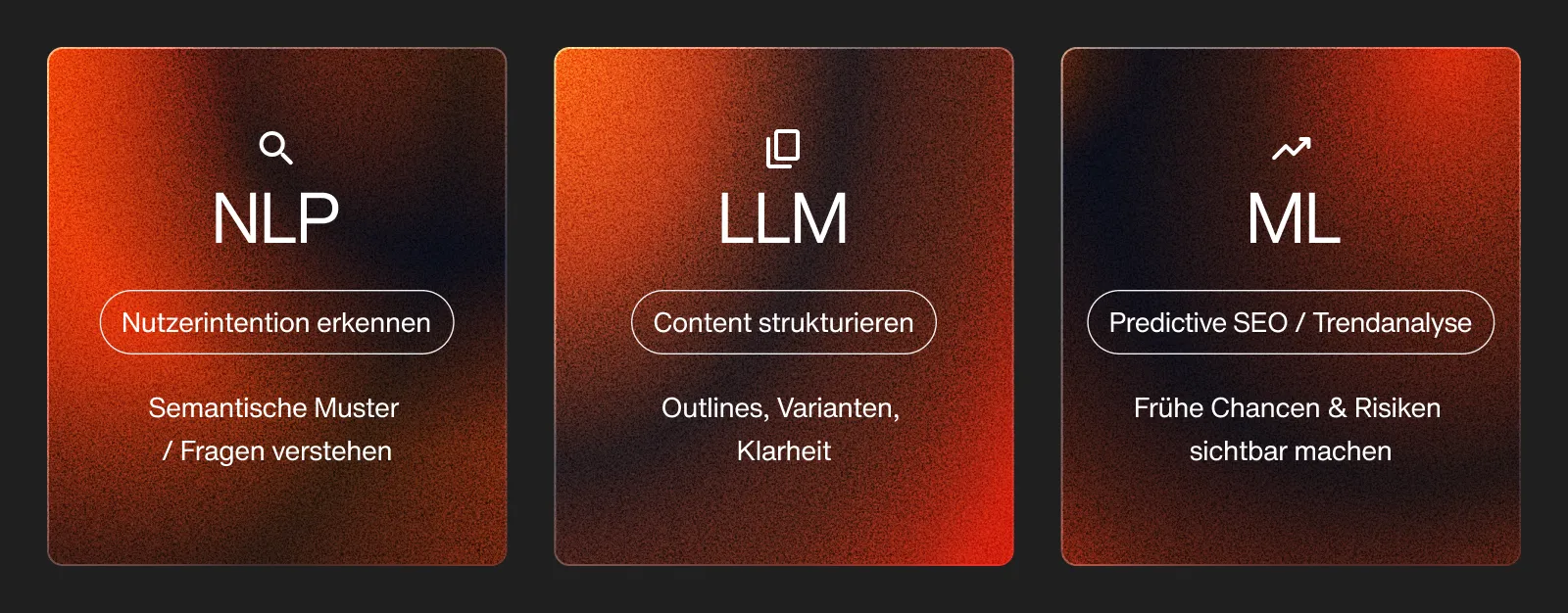
How AI and NLP speed up SEO workflows — when used correctly
AI is effective not through pure automation, but through intelligent assistance. Used correctly, it is used as an NLP and LLM-based analysis and structure tool, which relieves teams and at the same time improves the user experience and quality of the website.
1. Keyword research and topic analysis with NLP
Thanks to NLP and AI tools for SEO, AI recognizes semantic patterns, user questions and topic gaps faster and more comprehensively than traditional research processes. It shows priorities, content gaps and opportunities with a high level of detail.
2. Content briefings and structure development
NLP supports the creation of SEO texts, outline generation, structural logic and thematic embedding. This creates a clear framework that facilitates the production of high-quality, search engine optimized content.
3. Optimization and quality testing
AI checks readability, structure, internal linking, semantic consistency, and meta data using NLP algorithms. This ensures efficient quality control and improves SEO analysis.
4. Snippet optimization
Variants for titles, meta descriptions and FAQs can be tested and optimized faster with NLP. This increases the click rate and visibility in Google AI overviews and other search engines.
5. Predictive SEO
Machine learning models, supported by NLP, help with trend analyses and show where rankings will rise or fall. In this way, SEO is proactive instead of reactive and the SEO strategy is data-driven.
The result: AI combines content, data and technology to create a more efficient SEO process: precise, fast and measurable.
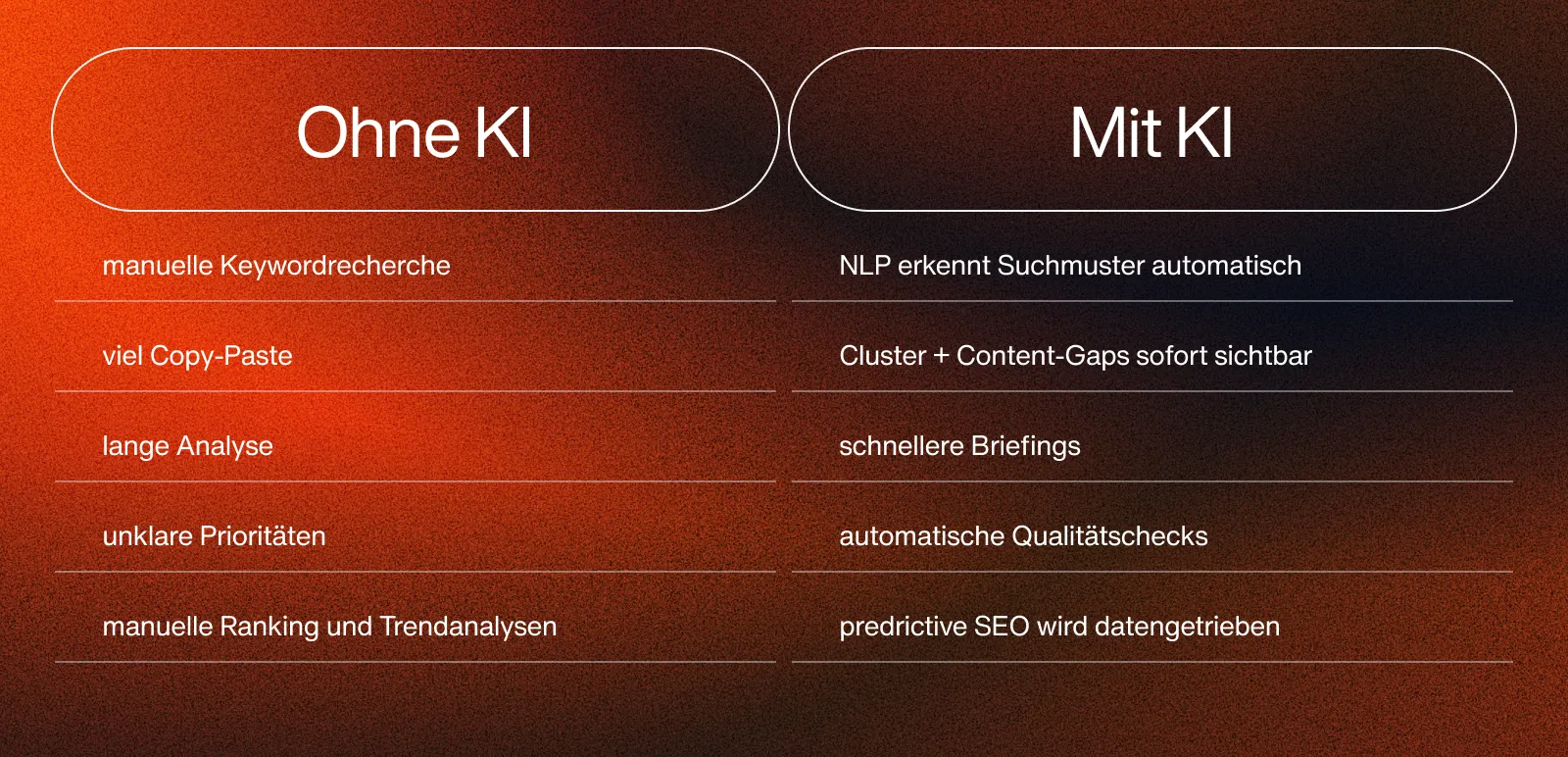
Why AI makes content smarter — thanks to NLP, not more generic
Used correctly, AI noticeably improves content quality:
- Clear structures through semantic analysis
- Better readability thanks to NLP optimization
- Consistent logic based on language comprehension
- More precise answers to user questions
- Data-based prioritization through NLP insights
The challenge lies not in the technology, but in the process. AI can create variants but cannot develop a brand identity. It provides raw material, but not husbandry.
That is why we at BWS rely on an approach that combines speed and quality:
“AI accelerates data evaluation and topic finding through NLP and LLMs.
We take on strategy, structure, tonality and final quality assurance.
This is how we combine speed with brand quality — efficiently, consistently and cleanly managed.”
In this way, content remains brand-typical, high-quality and close to the target group.
Risks: When AI harms SEO instead of supports it — and how we avoid it
AI is a powerful tool, but only an advantage if managed strategically. The potential stumbling blocks lie less in the technology itself, but in unstructured processes.
1. Consistency instead of mass
AI enables rapid production. It is crucial to clearly prioritize topics and to design content consistently. In this way, the brand image remains stable — even at high frequencies.
2. Ensure compliance with facts
AI generates content probabilistically, not based on documents. Careful review ensures that information remains accurate, cleanly researched and credible.
3. Maintain your brand voice
AI creates variants, but brand identity is created humanly. With clear guidelines, the tonality remains consistent and recognizable.
4. Avoid duplicate content
Structured workflows prevent redundant content and ensure that content remains clearly focused.
Our approach at BWS: We work with AI support, but always with clear editorial guidance. This is how we combine efficiency, data quality and brand precision — without loss of quality.
Strategic learnings for CMOs
For CMOs, AI in SEO means: Strategies must be faster, more data-based and more cleanly structured.
What successful companies are doing now:
- Define clear AI and NLP guidelines
- Establish processes for quality control
- Combine AI analyses with human editing
- Invest in Brand Voice and Tone
- Integrate AI tools for SEO into their content roadmap
- Strengthen data-based decisions and SEO optimization
AI is becoming a tool that strengthens teams, not replaces them. Brands that strategically lead AI gain speed and relevance.
Conclusion
AI is changing SEO — not through automation, but through assistance. Thanks to NLP and large language models, it speeds up research, improves analysis processes and makes content production more efficient. But real visibility continues to arise where brands are clearly positioned, deliver high-quality content and are strategically managed.
The future belongs to companies that do not imitate AI, but integrate it — into their processes, their content and their brand identity. At BWS, we develop AI-powered SEO strategies that combine speed with quality. Everything in-house. No detours. It's now or never. Let's talk.
FAQ
How does AI actually help SEO teams?
AI accelerates research, analysis, and content creation through NLP and LLMs. Teams work faster, more efficiently and based on data.
Can AI replace human content creation?
No AI supports structures, variants, and analyses. Strategy, tonality, and quality control remain human.
What tasks should AI take on?
Analysis, topic selection, structure, variants, snippet optimization and quality checks.
Which tasks remain human?
Brand management, tonality, strategic decisions, storytelling and content responsibility.
How do you prevent generic AI content?
Through clear guidelines, editorial guidance and a precise brand voice.