SEO Myths in Fact Check: What Decision Makers Really Need to Know
l
Webdesign
Webentwicklung
Branding
Animation

Around a third of marketing teams lose SEO potential Due to incorrect prioritization, lack of data and lack of structure. Between blog posts, agency promises and YouTube tutorials, there are countless SEO myths that mislead even experienced marketing teams.
However, the SEO principles are now clearly defined: Search engine optimization is data-based, technically precise and continuous. If you want to build sustainable visibility, you don't need tricks, but an understanding of how search engine optimization works.
At BWS, we combine creative content with measurable performance. Our Approach: SEO as a Process — Not as a One-Off Measure. In this article, we'll show you how to leave ten-year-old myths behind and use modern SEO as a strategic growth channel.
Myth 1: “SEO is a one-time measure”
Many companies believe that a relaunch or a few new SEO measures are enough. But search engines change every day — Google makes several thousand changes a year. Without continuous optimization, every website loses visibility because rankings are displaced by new content.
Many sites without ongoing updates often lose over half of their traffic within twelve months. Reasons: Outdated content, new competitors, changed search terms.
SEO basics:
- SEO is an ongoing process
- Monitoring via tools such as Google Search Console is mandatory
- Monthly audits ensure rankings and technical stability
Anyone who sees SEO as a continuous process lays the foundation for long-term results.

Myth 2: “More keywords = better ranking”
Keyword stuffing is one of the most well-known common SEO mistakes. In the past, the more keywords, the better. Today, Google understands the context. Using AI systems such as BERT or MUM, the algorithm recognizes semantic relationships — not just repetitions of words.
This means that content must be thematically complete and tailored to the user intent. Modern SEO best practices rely on topic clusters instead of keyword density.
Our tips for search engine optimization:
- Main keyword 1x in meta title, 1x in H1, 2—3x in text
- Integrate long-tail keywords with FAQs
- Content Strategy Instead of Keyword Lists
Relevance, structure and readability count for more than just density. For decision makers, this means thinking holistically about SEO issues — with a focus on utility and user experience.
Myth 3: “SEO results are immediate”
Many teams expect short-term rankings after the start of new campaigns. But SEO is not an immediate measure, but a long-term investment.
Search engines must first crawl, rate and compare content with existing pages. New websites or landing pages take time to build authority. According to analyses, it takes an average of 4-6 months until the first top 10 placements become visible.
Best practice for sustainable results:
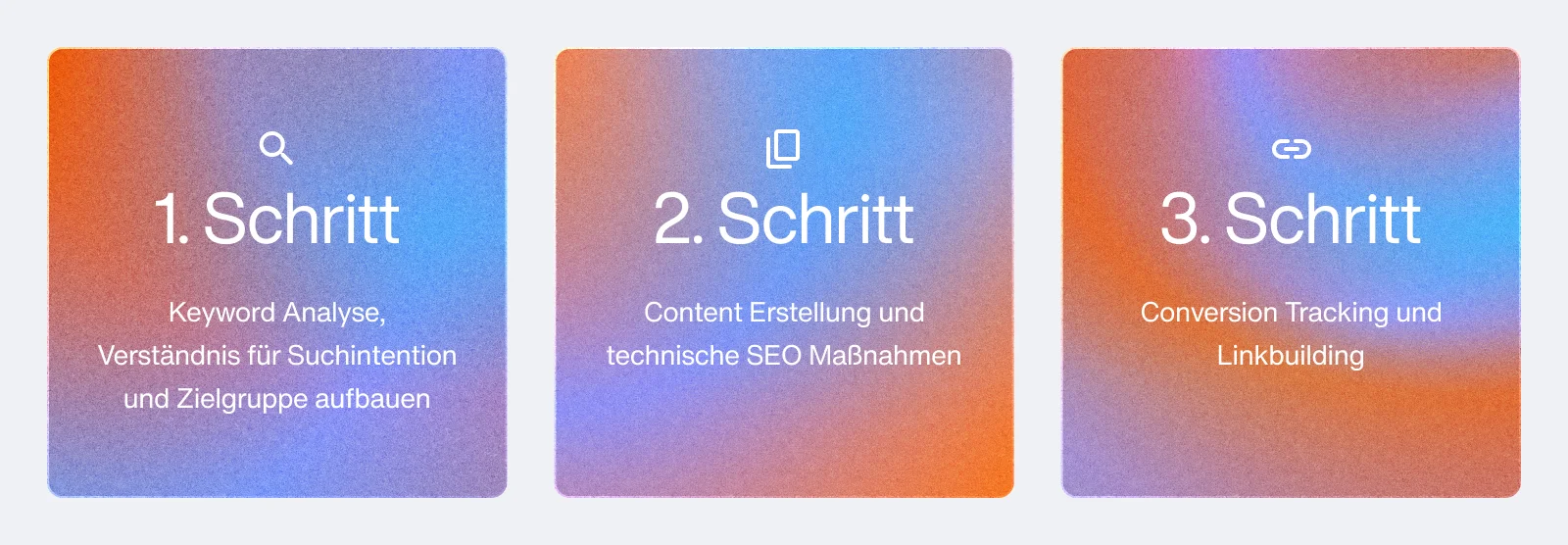
- Step 1: Keyword analysis, understanding of search intent and target group
- Step 2: Content creation and technical SEO measures
- Step 3: Conversion Tracking and Link Building
SEO is a marathon. But anyone who continuously optimizes benefits from exponential growth — particularly in organic traffic.
Myth 4: “Technology is Everything”
Fast load times, structured URLs and clean URL structure are important — but they only account for around 15% of ranking success. Technical SEO is the foundation, but ranking is determined by content and trust.
Google rates pages according to E-E-A-T:
- Experience: Personal experience (e.g. case studies)
- Expertise: Technical depth
- Authoritativeness: Industry relevance
- Trustworthiness: Transparency and data quality
Technical SEO optimization ensures crawlability, but only high-quality content creates retention time and conversion. For CMOs, this means investing resources not only in load times, but in content, UX and off-page optimization.
Ranking factors at a glance:
- Content & user experience
- Technical SEO & on-page optimization
- Backlinks & Digital PR
Technical perfection alone is not enough — quality and user-centricity bring pages to the SERPs.

Myth 5: “SEO can be outsourced and forgotten”
Outsourcing without internal knowledge is one of the biggest strategic mistakes. agencies can carry out technical audits, SEO tools And provide link building, but do not replace a deep brand understanding.
Successful SEO requires a hybrid model: external expertise plus internal know-how. At BWS, we call this “shared intelligence.”
Success factors in the SEO-hybrid model:
- Name an internal SEO manager
- Close coordination with the agency
- Clear KPIs and comprehensible reports
The goal is always joint growth: agencies provide data and technology, the company provides content, context and brand depth.
Strategic learnings for CMOs
For marketing decision makers, SEO is not a checklist, but a system.
What you should keep in mind:
- Understanding SEO basics — the basis of every search engine optimization.
- Build the content strategy based on data.
- Review and further develop SEO measures regularly.
- Actively use tools such as Google Search Console and Ahrefs.
- Connect SEO with UX, Branding, and Development.
SEO only works when technology, content and strategy go hand in hand — and every decision is based on facts.
Conclusion
SEO is a long-term investment in digital brand management. Anyone who replaces old beliefs with data-based strategies gains sustainable visibility in search results. At BWS, we rely on high-level SEO: search engine optimization that has a measurable effect — creatively, strategically and 100% in-house. It's now or never. Let's talk.