UX/UI Design as a Conversion Driver: How User-Centered Design Increases Your Business Success
l
Webdesign
Webentwicklung
Branding
Animation
We all know the problem: You invest a lot in marketing campaigns, attract numerous visitors to the website — and yet there are no conversions. What is the reason for that? It is often not the product or the offer, but the user experience (UX) and the user interface (UI) of the website. In this blog article, we'll show you how we achieve measurable business success through strategic UX/UI design and consistent user testing (without endless A/B testing). You'll learn why conversion rate optimization is inextricably linked to web design usability, how usability testing enables well-founded design decisions and how user-centered interface design (UI) can increase conversion rates.
It's up to you: With an in-house, data-based and creative UX/UI design, you can inspire users, optimize conversion and thus sustainably drive your company's business success forward.
Importance of UX/UI Design for Business Success
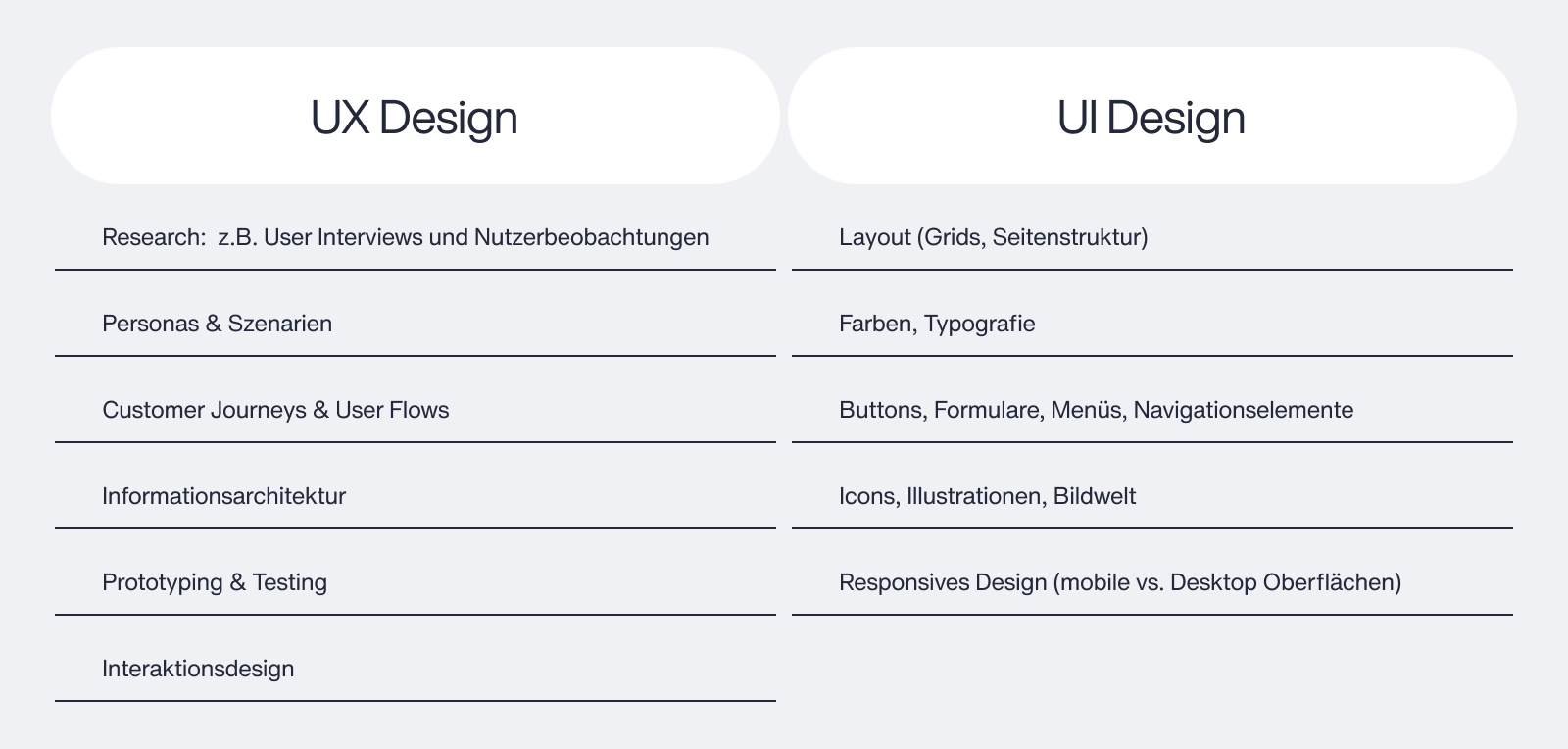
UX stands for user experience and describes the entire user experience of your customers with the digital product — from the first interaction to the completion of a desired action. UI stands for user interface and refers to the design of the user interface — i.e. the visual interface design with which users interact directly. Put simply, UX design focuses on how something works and feels, while UI design focuses on how something looks and is built. The UI-UX significance for your company is enormous: Only when aesthetics and usability work together can you create a positive user experience that engages and allows users to convert.
But why is this so important for business success? It's simple: A bad UX costs you customers — a good UX turns visitors into paying customers. Studies show that 88% Who do not send users back to a website after a bad experience. In other words, poor usability in web design scares away potential customers and allows marketing investments to fizzle out. An optimized UX/UI, on the other hand, ensures that visitors like to stay on your site, find their way around and actually carry out the actions offered (purchase, registration, etc.).
Another decisive factor: Long or complicated buying processes scare off. Good UX saves user clicks, makes processes faster and easier, keeps content clear and draws attention to the essentials. Anything that is unnecessarily distracting — such as excessive pop-ups or too many intermediate steps — leads to frustration and interruptions. Clear, reduced user guidance, on the other hand, creates trust and ensures that conversion paths run smoothly.
UX/UI design is therefore not a “nice-to-have,” but a tangible success factor. Anyone who invests in usability early on is rewarded: According to Forrester, every euro invested in UX generates an average return of 100 times. According to a McKinsey study, UX-optimized companies were able to increase their turnover within five years by 32% Increase more than your competitors. These facts speak for themselves. Good UX/UI design not only promotes customer satisfaction and user loyalty, but also has a direct impact on metrics such as conversion rate, revenue, and growth. In short: A positive user experience is transformed into tangible business results.

User testing as a basis for meaningful design decisions
So how do we create an excellent UX/UI design? The key lies in real user feedback. User testing — often referred to as usability testing or UX testing — means that we let real users try out our designs before we finally implement them. In targeted tests, we observe where users have difficulties, which elements work well and where there is a need for optimization. These findings form the basis for meaningful design decisions instead of relying on good feeling or pure assumptions.
Even experienced designers don't always hit the mark when they design in isolation in secret. Without user feedback, you run the risk of ignoring the needs of the target group. User testing provides us with the necessary data early on to avoid design errors before they become expensive. A well-founded UX strategy therefore includes qualitative usability tests with real users right from the start.
Important: User testing is not an A/B test. While A/B testing pitts two variants against each other to tease out marginal improvements, usability testing is about uncovering basic conversion blockers and usability problems. This approach brings to light the hidden pain points that you won't discover with mere analytics figures or A/B tests alone.
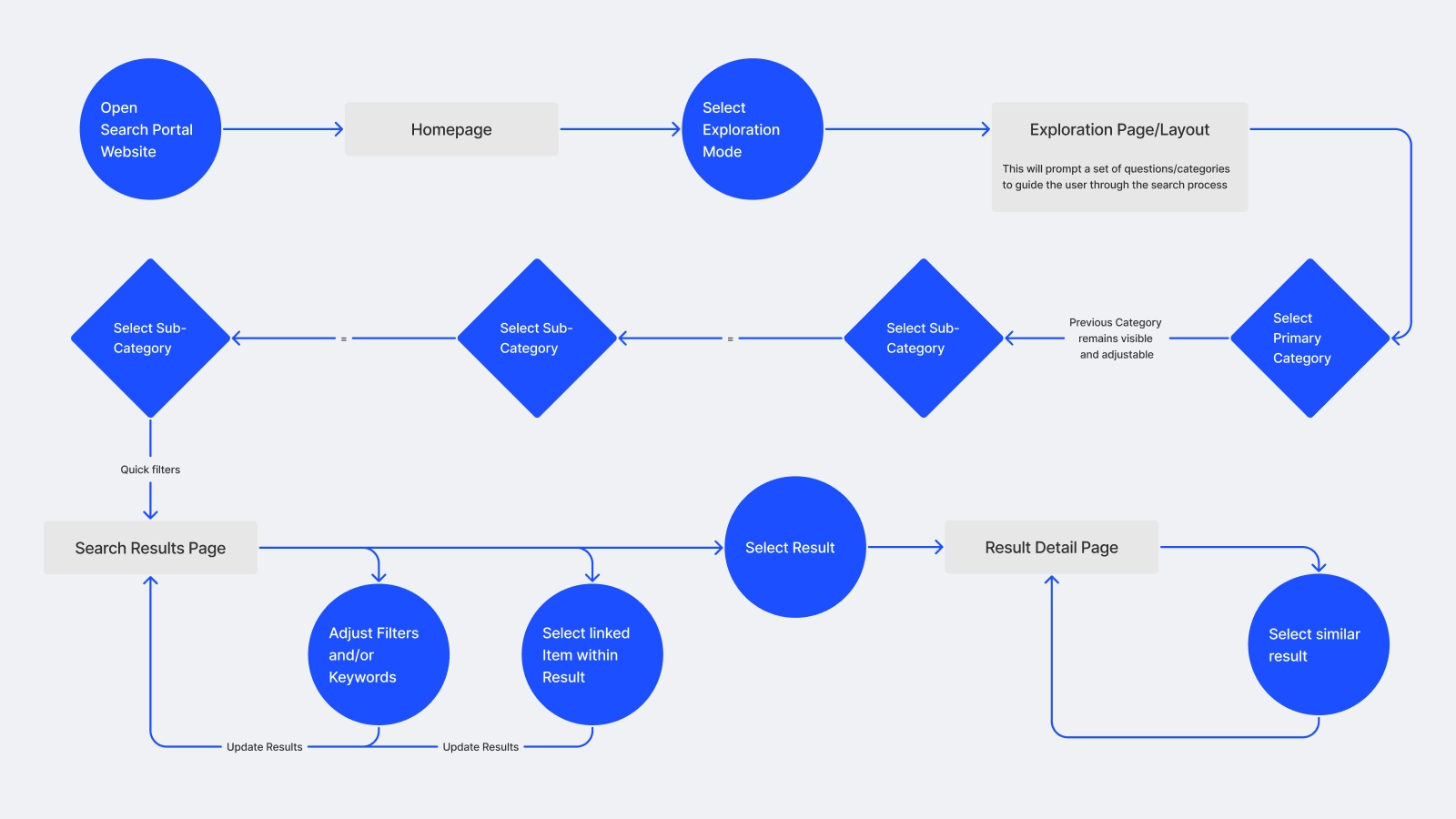
A decisive focus is on the Userflows: Where do users look, where do they click, where do they lose the common thread? Through user testing, these behavioral patterns can be precisely understood. This creates a clear understanding of how the target group actually behaves — and not just how the strategy assumes it. This is exactly where the biggest levers for real optimization lie.
Early testing also saves costs. Errors that only become apparent after launch are extremely expensive to fix. If, on the other hand, discrepancies are identified during the design process through user research and UX testing, they can be corrected much more cheaply. It is much more efficient to improve a click prototype than to change a live-programmed website later. Through iterative testing and adjustments before development, we avoid expensive revisions and end up with a product that really meets user requirements. In short, usability testing provides the data-based insights to make UX/UI design decisions in a targeted manner — a basis that CMOs should build on to avoid manufacturing past the market.
How good UX increases the conversion rate
An excellent user experience has a direct impact on your conversion rate — i.e. the percentage of visitors who take a desired action. The mechanism behind this is simple: The fewer barriers and frustrations, the higher the probability of a conversion. An intuitive interface, fast load times and clear call-to-action elements (CTAs) ensure that users easily find what they're looking for and are happy to take the next step.
Conversely, long loading times, confusing navigation, or an unnecessarily complicated checkout process lead to frustration and cancellations. Any unnecessary click or moment of doubt can cause someone to abort the process and migrate to the competition. The result: loss of conversion. A good UX eliminates such pitfalls: It keeps the buying process lean, the information clearly understandable and always focuses users on the next step in the funnel. In this way, visitors are gently guided towards conversion without feeling like work.
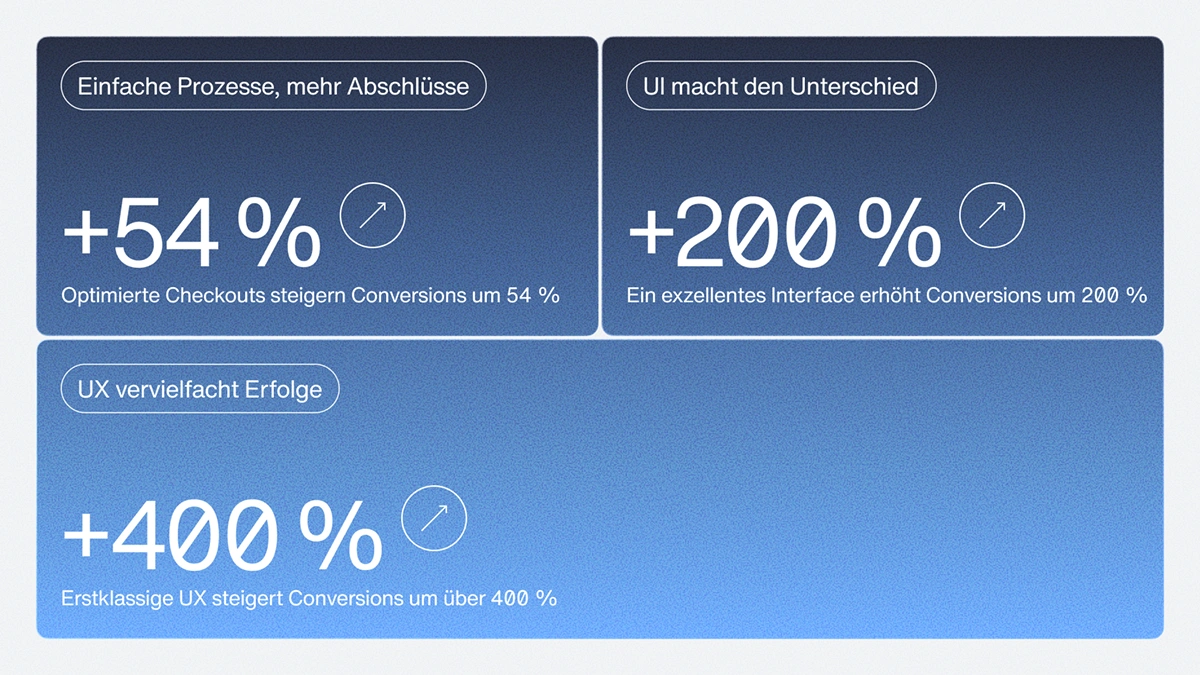
The fact that good UX design can measurably increase the conversion rate is proven by data. One Baymard Institute Study Revealed that optimized checkout processes in e-commerce increase the conversion potential by Be able to increase by up to 54%.
Forrester Shows: An excellently designed user interface can increase the conversion rate by up to 200% increase — and when the entire user experience (UX) is top-notch optimized, Increases of over 400% possible. In other words, thoughtful design can multiply the success of your website.
We also know numerous practical examples of how conversion optimization can be achieved through UX. UX improvements, such as clear and convincing CTAs, concise content, and mobile optimization, often lead directly to higher conversion rates. Even technical UX factors play a role: So reported WalmartThat every second of faster loading time increases conversion by around 2% — a seemingly small detail with a big effect. However, usability and content remain the most important levers: When users find exactly what they expect and feel well received, trust and willingness to buy increase.
What CMOs can strategically derive from this
For you as a CMO or marketing manager, this means that UX/UI design is on the strategic agenda. It is not enough to see conversion rate optimization just as a task of performance marketing. Instead, the findings from UX testing and user research should be incorporated as an integral part of your marketing and product strategy.
- Invest in user centricity: Make sure your team really understands users' needs. Focus on UX research, user testing and iterative design processes.
- Collaboration between marketing and UX: Bring both teams together. This is how you optimize the customer journey from the first advertising contact to onboarding.
- Data-based approach: Use web analytics, conversion funnels, and feedback from user tests. Define KPIs against which both marketing and UX measures are measured.
- Continuous optimization: UX/UI is not a one-time project. User needs are changing, UI design trends are evolving, and competitors aren't sleeping. Regular testing and feedback rounds ensure an advantage.
Strategic UX/UI design is a powerful lever for achieving business goals. For CMOs, UX is not an operational detail, but part of the corporate strategy.
Conclusion
Increasing conversion rates, increasing user loyalty, achieving measurable sales growth — all of this is possible when UX/UI design is consistently thought of from the user perspective.
At BWS, we are convinced that the best marketing campaign fizzles out without a convincing user experience. Conversely, an outstanding UX can ensure organic growth even with lower budgets. The key lies in a data-based, creatively implemented UX/UI design that is continuously validated through user testing.
This creates digital experiences that not only please, but also perform.
In the end, every euro invested in usability and design pays off many times over — in the form of conversions, customer satisfaction and long-term business success.
It's now or never. Let's talk.
FAQ
What does UX/UI design mean?
UX stands for user experience and comprises the entire user experience. UI stands for user interface and describes the design of the user interface. Both disciplines are intertwined — an appealing UI is of little use without good usability behind it.
What role does UX play in conversion rate optimization?
A central one. Good UX removes hurdles, increases trust and turns interested parties into customers.
What is the difference between user testing and A/B testing?
User testing provides qualitative insights: why users have problems. A/B testing compares variants quantitatively.
What UI design trends should you be aware of in 2025?
Personalized user experiences, mobile-first, micro-interactions, and barrier-free interfaces.
How can success be measured in UX/UI design?
On KPIs such as conversion rate, bounce rate, stay time, and return rates. Complemented by qualitative feedback from users.