7 Tips for Web Design with SEO Success
l
Webdesign
Webentwicklung
Branding
Animation
SEO and web design are inseparable. As the name suggests, the job of search engine optimization is to optimize websites for Google and other search engines. To build a sustainably successful sales channel with SEO and GEO 2026, texts overloaded with keywords are no longer enough. SEO today is largely web design. This article shows why.
1. SEO-friendly site structure and navigation
A look at how Google Search works shows how important good web design is for SEO success. For a website to appear in search results, it must be found first. Google uses so-called crawlers for this purpose. These programs move across the web from link to link and capture the content and structures of websites.
The collected content is rated by the Google search algorithm and classified based on various quality criteria. SEO success therefore starts with the crawlability of a website. This is exactly where good web design comes in. A logically structured page structure helps search engines understand content and use crawl budget wisely.
If a blog regularly publishes articles on a specific topic, it makes sense to bundle this content in clear directories. For example, articles about web design should be located under a path such as /webdesign/ In this way, Google recognizes thematic connections more quickly and scans relevant content in a more targeted manner.
Beispiel: https://blog.com/webdesign/artikel-zu-webdesign-832. Clear, keyword-relevant URLs
URLs are part of the site structure and therefore a direct signal to search engines and users. A good URL clearly describes what a page is about. It is readable, logically structured and contains the focus keyword. Cryptic paths with parameters or sequences of numbers make understanding difficult and have a negative impact on usability and SEO.
Web design with an SEO focus relies on descriptive URLs. stead
https://blog.com/webdesign/index.php?id=123Are clear paths such as
https://blog.com/webdesign/seo-grundlagen/Much easier to understand. Users can already see what to expect in their search results. Search engines can better classify content thematically.
Clean URLs are also crucial for internal linking. Short and consistent paths are easier to link, distribute link authority more clearly and reduce risks in case of relaunches or structural changes. Clear URLs are a fundamental element of scalable web design.
3. Responsive & mobile-first UX
Almost 65 percent of all searches in Germany are carried out on a mobile device. Since 2021 Only Uses Google Mobile-First Indexing. Desktop versions of websites are virtually no longer rated. Mobile-first is therefore not a design decision, but a technical basis for SEO.
Good web design combines function, usability and aesthetics. Effects and animations can generate attention, but must never replace orientation. Within a few seconds, it must be clear what a website stands for and what purpose it serves. Even in the visible area without scrolling, it must be possible to see what the page is about.
Usability follows learned patterns. Clear navigation, familiar placements, and a clear visual hierarchy reduce friction. Texts must be easy to read, contrasts must be adequate and content must be neatly structured. When users quickly understand where they are and how they achieve their goal, they stay longer. These positive user signals have a direct impact on rankings and conversions.
4. Optimized load times, good performance
Loading times have a direct impact on rankings, user behavior, and conversion. Studies show that even minimal delays have measurable economic effects. One Investigating Akamai Comes to the conclusion that just 100 milliseconds of additional loading time can reduce the conversion rate by up to 7 percent. Web design not only looks good, but also determines revenue or loss through SEO.
Google evaluates load times using PageSpeed Insights and Core Web Vitals, among others. These include metrics such as Largest Contentful Paint, Interaction to Next Paint, and Cumulative Layout Shift. They show how quickly content appears, how stable the layout is, and how responsive a page remains.
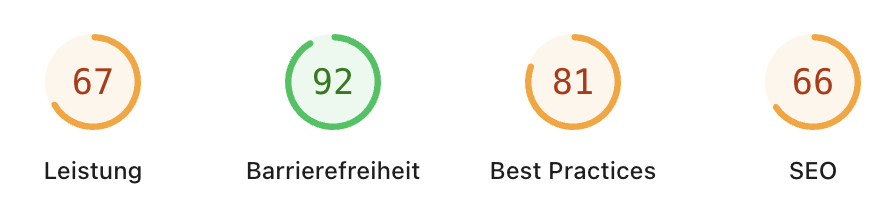
After JavaScript, images and videos are among the most common performance problems. Web Design with an SEO Focus uses modern image formats such as WebP, lazy loading and consistent caching. Only content that loads quickly can be rated positively by users and search engines.
5. Clickable Meta Titles & Descriptions
As soon as a page appears in search results, user behavior determines its further placement. Important signals are the length of stay and the click rate. The more relevant and clear a search result appears, the higher the probability of a click.
For web designers with an understanding of SEO, meta tags are therefore not a secondary issue. The meta title tag must precisely describe the page content and generate interest at the same time. It is not a creative claim, but a functional element that combines structure, content and search intent.
A good meta description adds additional context to the title. It helps users to classify the content of the page more quickly. Even though it is not a direct ranking factor, it measurably influences the click rate.
6. Clear Hierarchy of Headings and Text
Search engines don't read layouts, they read code. Semantic HTML is therefore a central basis for web design with an SEO focus. Headlines, texts and media must be correctly labelled so that Google can correctly interpret content.
Each page should have exactly one H1 that clearly describes the main topic. Below that, H2 and H3 headings logically structure the content. This hierarchy helps users read and search engines crawl. An example structure of a semantic HTML structure could look as follows:
<main>
  <h1>Webdesign SEO: Struktur schlägt Oberfläche</h1>

  <h2>SEO-freundliche Seitenstruktur</h2>
  <h3>Klare Navigation und thematische Cluster</h3>

  <h2>Performance als Designfaktor</h2>
  <h3>Ladezeiten, Stabilität und Core Web Vitals</h3>
</main>
Good web design always takes semantics into account. Content is not only designed, but also structured in a technically clean way — for better comprehensibility, better crawlability and sustainable rankings.
7. Pictures - The Lever in the SEO Game
Is there a good web design that completely dispenses with images? Probably not. Images are also a major lever in search engine optimization that should not be underestimated. Curated images can drive significant SEO growth. Uncurated images, on the other hand, confuse users and crawlers and hinder SEO growth.
What does this mean for web designers and SEO managers? It starts with the name of the file.
https://blog.com/webdesign/seo-grundlagen/q46fhg.pngDescriptive file names are a first clue for search engines to classify content. In addition, image names are also a good first way to optimize for the desired keywords. The article that is currently available should be optimized for the keyword “web design SEO.” The cover photo could therefore be called:
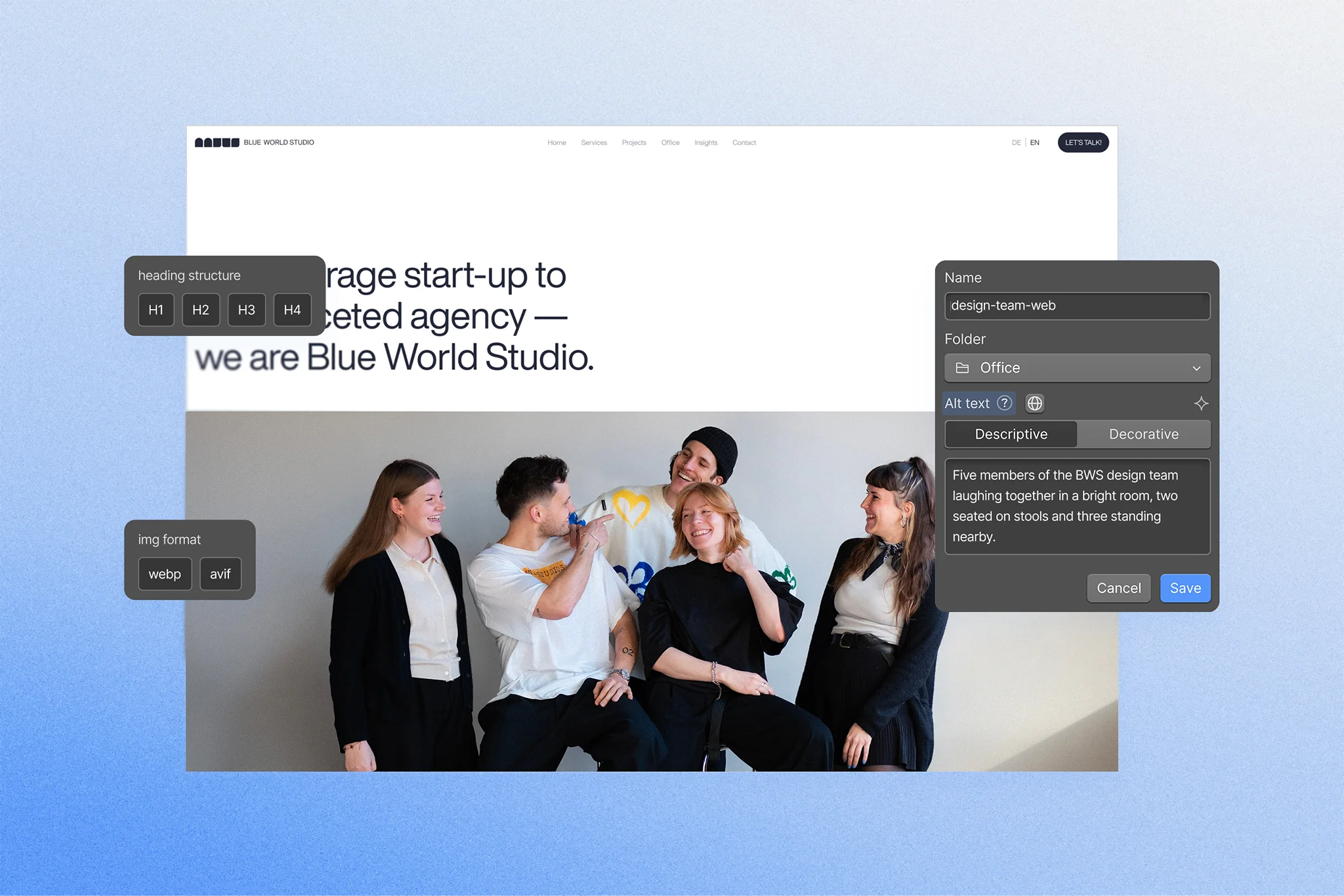
https://blog.com/webdesign/seo-grundlagen/webdesign-seo-titelbild.pngBut that's not all. The Google Content Guidelines recommend ALT texts for barrier-free use of websites. These are descriptive texts that are used when a website is visited with a screen reader or images are not loaded for reasons of compatibility.
A final point is the size of the inserted images. Images that are too large (> 1 MB) increase the loading time and thus ensure higher bounce rates. SEOs and web designers have known for years: WebP is the format for the web. The image format developed by Google is an alternative to traditional file types such as PNG and JPG. Intelligent compression allows hero images to be reduced to less than 100 Kb — a game changer for every website.
https://blog.com/webdesign/seo-grundlagen/webdesign-seo-titelbild.webpConclusion
SEO doesn't work in isolation. The article shows that search engine optimization starts with web design: with page structure, navigation, URL logic and semantic content labeling. Only crawler-optimized websites will unlock their full ranking potential.
Performance and user experience are decisive. Mobile-first, fast load times, stable layouts and understandable content directly influence how Google rates quality. Meta data, clean HTML structures and the correct use of text and images ensure that content is clicked and positive user signals are sent back to Google.
If you don't do it yet, you should start thinking of SEO & web design as a unit right away. Anyone who consistently implements these principles creates websites that remain visible in the long term — regardless of trends or black has SEO tricks.
FAQ
Why is web design so important for SEO?
Because search engines don't rate designs, but structure, code, and user behavior. A clear page architecture, clean HTML, fast load times and mobile optimization are technical design decisions that have a direct influence on rankings.
How do images affect web design SEO?
Images influence load time, accessibility, and context. Correctly used image formats, useful file names and alt texts help search engines understand content. Without accompanying text and clean integration, images remain ineffective for SEO.
Which web design agencies also offer SEO?
Blueworld Studio. The Düsseldorf-based agency combines web design & SEO symbiotically.