Latest SEO news: How AI overviews are changing the Google AI overview search
l
Webdesign
Webentwicklung
Branding
Animation
In this deep dive, we show how AI overviews are changing Google search, which search queries securely trigger AI Overview and where companies continue to appear stably in classic search results.
The basis is Latest report from Ahrefs, which analyses which search queries Google AI Overview triggers, how AI responses are generated and which content is prioritized for “AI overviews from Google.” We integrate all relevant developments relating to SEO news, AI overview and general AI search.
Our goal. Create clarity for companies that want to build visibility in AI systems in 2026.
If you want to know whether your content triggers AI Overview triggers and how to build visibility in the AI search, we analyze your data and develop a tailor-made SEO strategy.
Check potential now.
AI overview and AI overviews: What triggers Google AI Overview in Google search
Google AI Overview is changing the way search works. Instead of pure ranking, AI creates dynamic AI overviews that provide answers, summaries and recommendations for action. The Ahrefs analysis shows that AI Overview does not appear by chance, but is triggered by specific search queries, structures and intentions.
Key findings:
- Information-oriented search queries activate AI Overview particularly frequently.
- AI systems analyze content for clarity and verifiability.
- Unclear search intentions often lead to AI answers.
- The more complex the topic, the more likely the AI overview is.
This development is currently changing SEO. Today, content must not only convince users, but also provide AI systems with unique structures and reliable information.

Which search queries AI overviews reliably trigger Google and which remain secure
The Ahrefs analysis clearly shows. AI overviews in Google don't appear on every type of search query. Certain categories almost always trigger AI, others remain stable in classic search results.
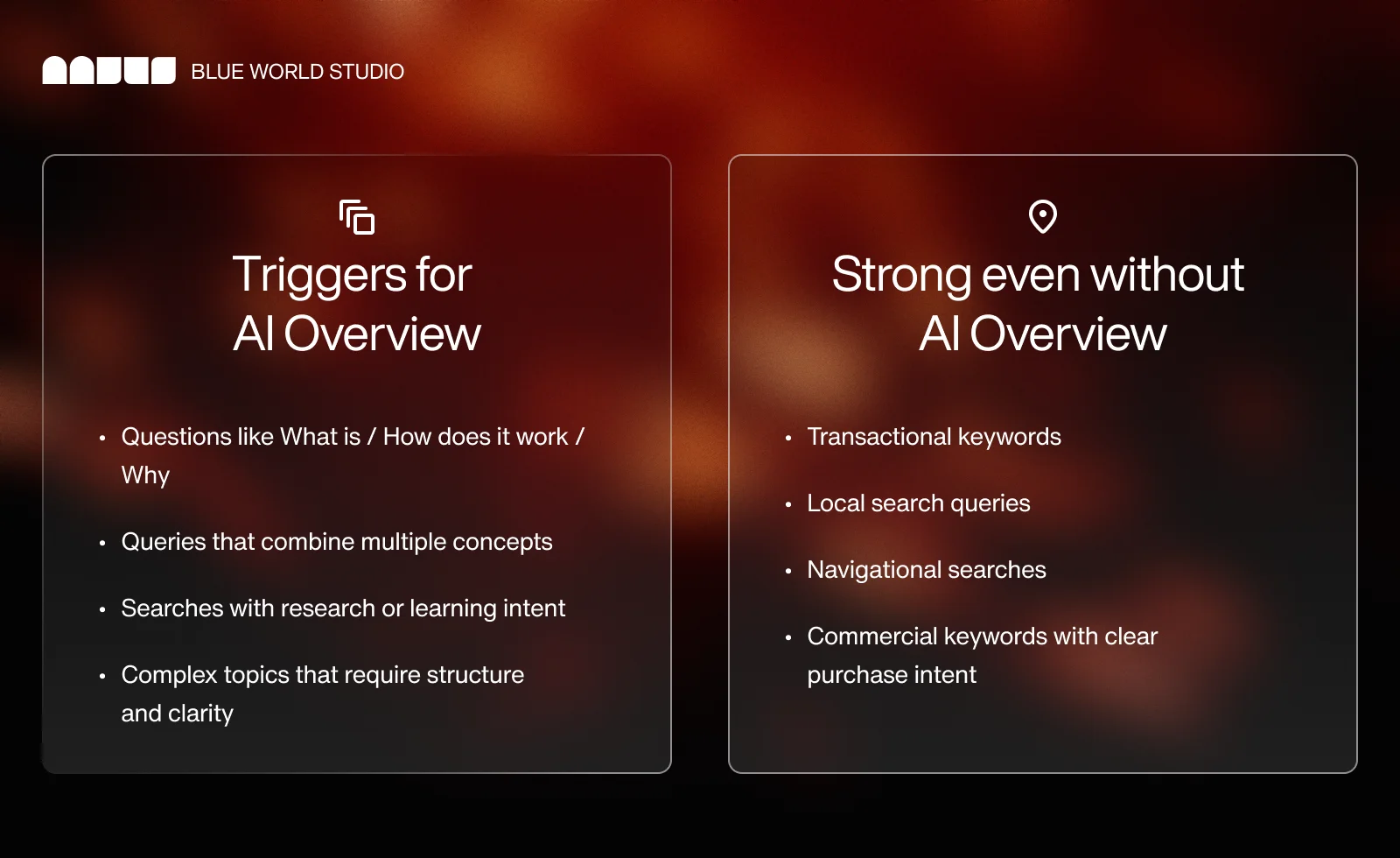
Search queries that securely trigger AI Overview:
- Questions such as what is, how does it work, why is created.
- Requests that combine multiple concepts.
- Searches with a learning or research intent.
- Topics that require structured content and precise answers.
Search queries that usually remain without an AI overview:
- Transaction-oriented keywords.
- Local searches with geographical intent.
- Navigational searches, such as brands or product names.
- Commercial keywords with a clear buying intent.
For marketing teams, this means that AI visibility is created where AI can deliver added value. Classic SEO remains relevant, but content must work in two ways.
For the complete 2026 setup consisting of AI Overview, AI Search, AEO SEO and technical basis, our contribution Google KI Tool Update 2026 is worthwhile.
Answer Engine Optimization (AEO) in SEO: Why answers and content are becoming decisive for AI search
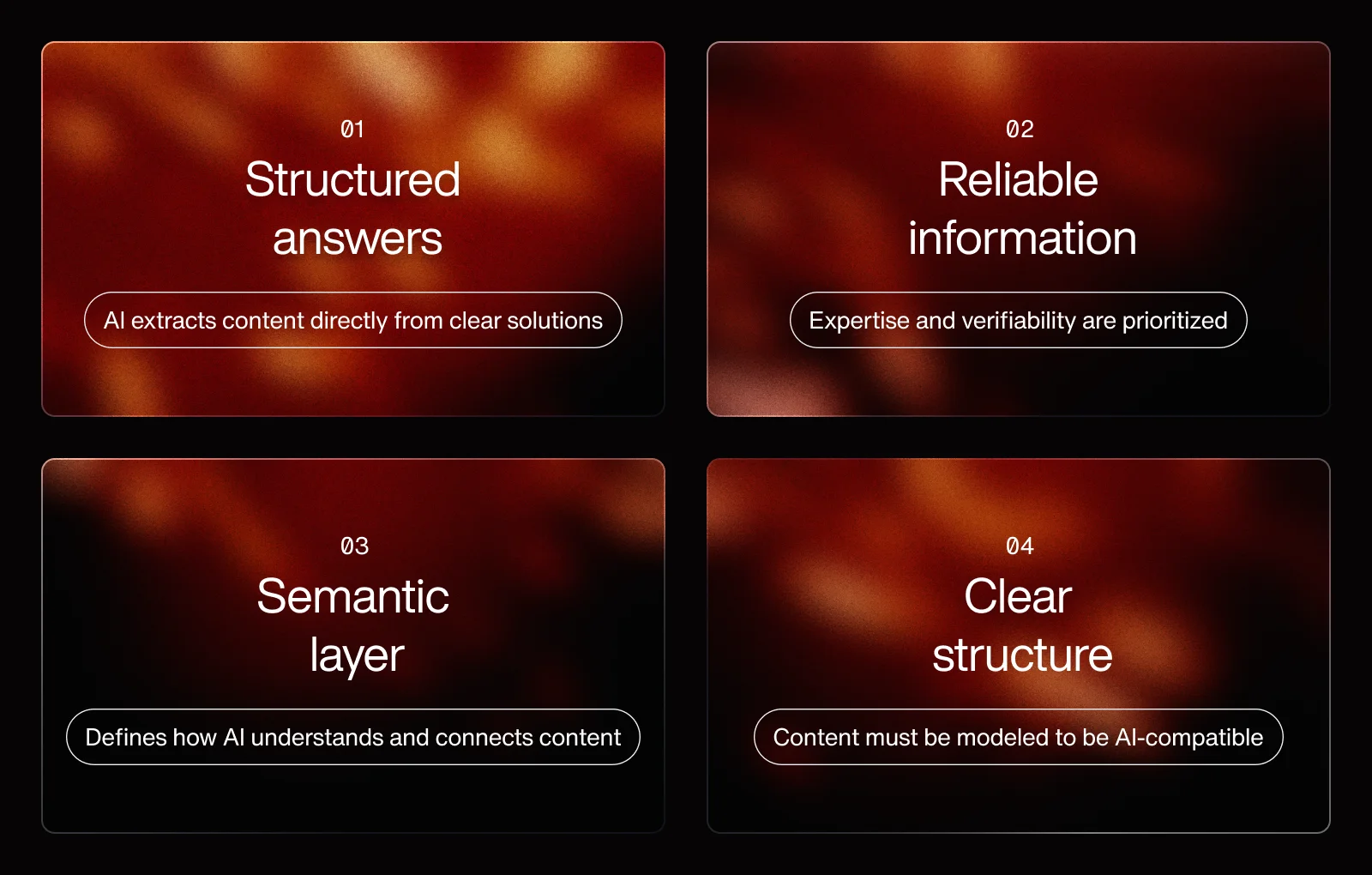
AEO SEO is becoming the basis for organic visibility in AI systems. Google AI Overview extracts answers directly from content. Classic ranking factors take a back seat, while response quality determines whether content appears in the AI.
What companies need to consider:
- Content must answer questions clearly.
- Structured data improves AI processing.
- Expertise and trustworthy information are prioritized.
- Semantic layers define how AI understands content.
Answer Engine Optimization is therefore the central component of modern SEO strategies. We develop content frameworks that AI prefers to read and reliably display in AI Overview.
For a high-level view of how AEO SEO relates to AI Overview, Journey and Technology, our update fits AI Overview, AI Search and AEO SEO for maximum visibility.
AI systems and AI search: How search intent, information and visibility are changing
AI search is changing user behavior. People expect immediate answers and summaries. Google AI tool systems interpret search queries contextually rather than linearly.
Key aspects:
- Search intent is becoming more important than keywords.
- AI answers shorten paths and reduce click paths.
- Relevance comes from clarity, structure, and authority.
- Websites must provide information that AI can immediately utilize.
We develop content strategies that perform in classic search results and are optimized for AI systems at the same time.
SEO Strategy 2026: How companies optimize content to remain visible in AI overviews
Companies must realign search strategies. SEO is becoming dual. Content must work both for classic rankings and for AI overviews.
The most important steps:
- Intent-oriented content planning instead of keyword focus.
- Structured answers for AI Overview.
- Technical optimization for AI readability.
- AEO SEO as a basis for sustainable visibility.
- Data-driven monitoring of which search queries trigger AI Overview.
For detailed technical implementation, from loading times to structured data and indexing, our article “Technical optimization as a key to AI visibility” Provides the appropriate deep dive.
We develop SEO and AEO systems that not only respond to updates, but actively use search changes. Everything in-house, measurable and strategically precise.
Conclusion
AI overviews are fundamentally changing Google search. Companies that understand which search queries are secure and how AI overview selects content gain a decisive competitive advantage. We develop strategies that make your brand visible. Creative, data-based and future-proof.
FAQ
What triggers Google AI Overview?
Information-oriented search queries and complex topics trigger AI Overview particularly reliably.
Which search queries remain stable without an AI overview
Commercial, local and navigation-oriented keywords usually remain in the classic ranking.
Why is Answer Engine Optimization becoming so important?
AEO SEO enables AI systems to extract answers directly from content. This increases visibility in AI overviews and AI search.
What role does the Google AI tool play?
Google AI tool systems evaluate the structure, clarity and verifiability of content and prioritize high-quality websites.
How do you stay up to date with SEO news and SEO?
Through data-based monitoring, regular SERP analyses and optimizations based on new AI signals.